

A Complete Guide to Wire Rope: Everything You Need to Know
What is wire rope?
A complete guide to wire rope is essential for anyone who works in industries that heavily rely on lifting mechanisms. Wire rope is a type of cable which is made up of several strands of metal wire laid or twisted into a braid or helix. Regular wire rope inspections are vital to ensure safety and reliability.
One of the most important purposes of carrying out wire rope inspections or testing is to oversee the process of depreciation in the wire rope. When any depreciation or deterioration is identified, these wire ropes can cease to be used immediately before they become a hazard. A great advantage of conducting these examinations is to analyze and identify if there is unexpected corrosion and destruction.
Wire rope inspection and testing
Commonly, there is a constant increase rate in the amount of wire rope breaks during the lifespan of that wire rope. Wire ropes need to be inspected and tested as they have a limited life, like all consumable products. Early in the life of the wire rope (when it is starting to be used), the wires and strands of the rope settle into position, and the breaking strength increases. Once it has hit its maximum, the breaking strength then decreases rapidly.
Wire rope inspections should only be carried out by highly trained professionals. There are two ways that these inspections are carried out on crane wire rope: visual and non-destructive. Visual and non-destructive examinations are equally as important, but a non-destructive wire rope test is a lot less frequent than a visual wire rope inspection. Destructive testing takes place only when specifically required by a company to find out what type of wire rope something is that has not been labeled and is not common practice in the general testing/inspections.
Visual inspection of wire rope
The visual method is a simple yet effective way to check for external damage to a crane wire rope. Visually inspecting the entire length of rope is crucial. The rope should be inspected 2 to 3 feet at a time and examined carefully at each stop. While inspecting the wire rope, it should also be cleaned with Lanotec and a wire brush. Although tedious, this method can determine many visual signs of wire rope damage such as kinks, bird caging, cutting, knots, flattening, crushing, and heat damage (burn marks, discoloration of the metal). Wearing heavy-duty gloves, an inspector will grab the rope and lightly move a rag slowly along the length of rope. Broken wires will often stick out and will therefore snag on the rag. Should the rag snag on a wire, the inspector should stop and visually assess the rope condition. However, broken wires do not always ‘porcupine’, so visual inspections should not be the only method relied on for inspecting crane wire ropes.
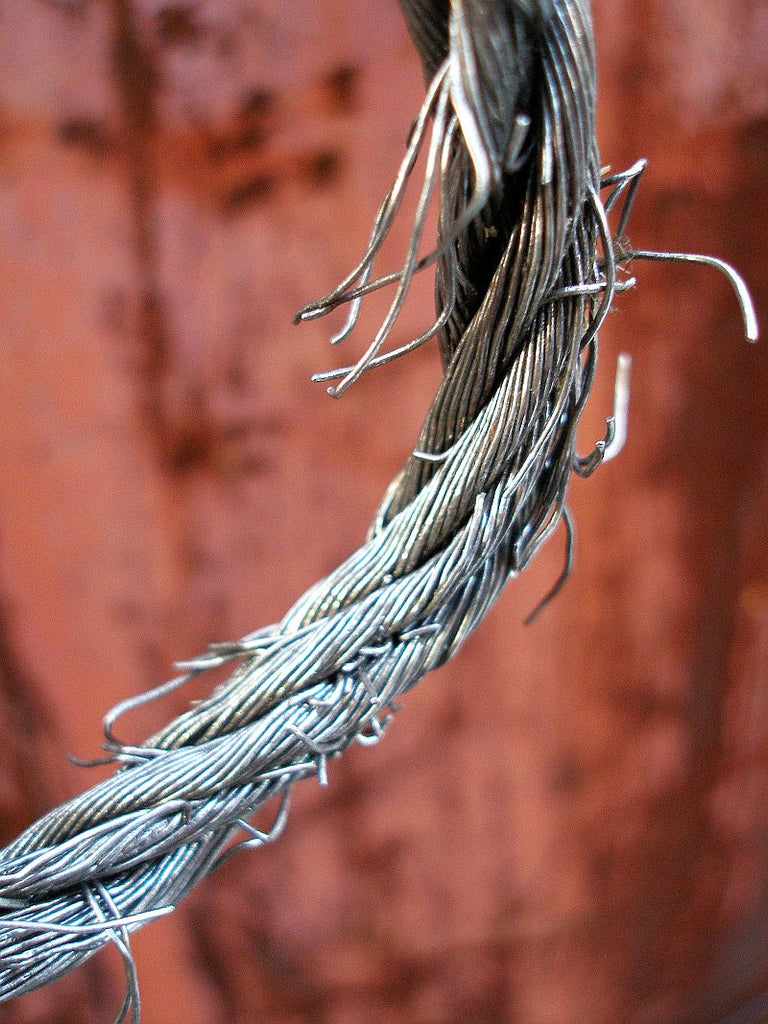
Due to the composition of a wire rope, the outer layer only represents approximately 40% of the metallic cross-section of the rope, and only approximately half of this is visible due to the strand twisting inside and out. This means that you are only able to visually examine approximately 20% of the entire rope composition, leading to the assumption that the other 80% is in good condition.
Internal wire rope damage
Although the external 20% may look in good condition, it may be concealing a great number of wire breaks and internal damage. Wire ropes with internal damage that have no signs of external damage can be extremely dangerous. This is why an internal wire rope inspection should also be completed. Internal deterioration is the primary cause of many rope failures, mainly due to corrosion and the normal progress of fatigue. Single-layer stranded ropes may be opened up slightly to allow an assessment of their internal condition, provided that they are at zero tension; though, some restrictions occur with large rope sizes. Permanent damage can be caused to multi-layer wire ropes if they are opened.
Internal wire rope inspection
Internal inspection should always be carried out by a capable person. The method of inspection consists of firmly attaching two clamping jaws of appropriate size at a suitable distance apart to the rope. During the inspection of sections of rope adjacent to terminations, it is adequate to use a single clamping jaw since the end anchorage system or a bar suitably located through the end portion of the termination may be used as the second clamp. By applying a force to the clamping jaws in the opposite direction to the rope lay, the outer strands separate and move away from the core. Care should be taken during the opening process to ensure that the clamping jaws do not slip about the outside of the rope. The strands should not be excessively displaced. When a limited opening is achieved, a small probe, such as a screwdriver, may be used to remove grease or debris obstructing observation of the interior of the rope. The crucial points that should be observed are:
State of the internal lubrication
Degree of corrosion
Indentation of wires caused by pressure or wear
Existence of wire breaks (these are not necessarily visible)
After inspection, a service dressing should be introduced into the opened part, and the clamping jaws rotated with moderate force to ensure correct replacement of the strands around the core. After removal of the jaws, the outer surface of the rope should be greased. Since it is impossible to inspect the interior of the wire rope over the whole length, suitable sections should be selected. For wire ropes that wind onto a drum or pass over pulleys or rollers, it is recommended that the lengths that engage the pulley grooves when the appliance is in a loaded condition be inspected. Those localized lengths in which shock forces are arrested (i.e., adjacent to drum and jib head pulleys) and those lengths exposed to the weather for long periods should be inspected. Attention should also be given to the length of rope close to its termination, especially for fixed ropes like stays or pendants. This is where a visual inspection is complemented by a non-destructive test.
Have a look at the video below that shows how wire rope is made and also how it breaks at testing.


